
Strength In Softness: A Conversation With Told Slant
Each song Told Slant graces the world with is a guttural musical incarnation of the shadows of self. Listening to Told Slant is a cathartic release, it feels like crying on your bedroom floor in the fetal position at 3am. With groundbreaking, basic chord progressions and quivering vocals, Felix Walworth – the brains and heart behind Told Slant – gives permission to explore the feelings that are often the least accessible, the most repressed, and the hardest to put into words. I wondered if it might be a little strange to see the self-proclaimed 'bedroom punk' act live. After all, Told Slant’s music bears witness to the most intensely personal of emotions. Shouldn’t that be reserved for solitary headphone listening on melancholy bus rides home?
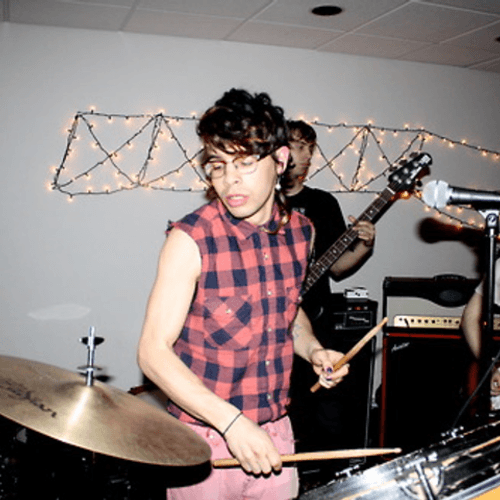
Approximately thirty seconds into Told Slant’s live set at San Francisco’s Bottom of the Hill, I was definitively proved wrong. The vulnerability and radical softness that characterizes Felix Walworth’s music found a mirror in its audience members. Fans sang their hearts out right alongside Felix. It became clear that these songs had offered many of the faces in the room an accompanying soundtrack to experiences of heartache and the quiet strength found in resilience. Told Slant’s music had made us feel understood in the solitude of our respective bedrooms, and now those bedrooms were connected in an invisible network. That night, Told Slant fostered the deeply human experience of discovering you are not alone in your innermost thoughts and feelings, of seeing and being seen, hearing and being heard.
After undergoing the emotional exorcism that is a Told Slant show, Golden Audio’s Nina Donoghue and I picked our jaws up off the floor, found some much needed fresh air at Bottom of the Hill’s outdoor patio, and sat down for a chat with Felix, who graciously granted us the opportunity to learn more about their profoundly personal musical project. We chain-smoked cigarettes and talked songwriting on-the-go (between Told Slant and their work supporting other bands in the Brooklyn music collective, the Epoch, Felix is nearly always on tour,) the necessity of community for uninhibited art-making, finding inspiration within bad days, and navigating times when inspiration lacks. Here’s what Felix had to say that day:
What is your songwriting process for Told Slant?
I start with lyrics and melodies, usually I’m just walking around and it’s all in my head. It’s sort of a reverse process from a lot of the folks that I know; where they’ll sit with an instrument and then write lyrics on top of it, whereas I spend a lot of time away from instruments because I’m often on tour. At least, accessible instruments, that I can write on in private. Usually I’m in a car, or when I’m home I’m walking around trying to be out of the car. So I’ll come up with lyrics and melodies in my head. Like I’ll have a phrase and I’ll think, 'Yeah! I killed it with that phrase, that’s where I’ll start.' Then when I’ve written enough, or I feel like I’ve fully explored some idea or feeling, I’ll return to my home and pick up a guitar and figure out the chords. I’ll build it out from the bottom. It’s almost like, the song falls out of itself. It’s not built, it’s expelled.
Simplicity is important to my songwriting, and I think it’s important on a level of accessibility for art. When you come to a show, there’s a silly idea that’s created by not only the physical space of the show, but also the culture around art, a culture created by capitalism – the idea that there are artists, and there are consumers of art. Which is nonsense, everyone can make things, everyone can make really beautiful things. Being able to convey something simply, and with really simple instrumentation that still has some sort of rigor and weight to it, can be more inspiring to folks who are at a show or listening to a record. Not just to be like, “Oh this is great. I’ll consume it as art,” but to be like, "Oh this is great. I can do this too, I can start a band and I can write words.”
How do you find inspiration to create?
I have no idea. I would say a lot of the process of being an artist is not being inspired? Which is a difficult thing to negotiate, as someone who wants to be articulating what they’re feeling in a beautiful way. A lot of times I’ll have this feeling that I want to convey, and I fail utterly over and over again. And there’s no set of circumstances or conditions that I can focus my life around, that will consistently allow me to produce art that I’m happy with. I feel like if anyone knew how to do that, it probably wouldn’t even be fun anymore, honestly. If you could just be like, “I’m gonna sit down and write this amazing piece of art right now,” with such clarity of vision, and so consistently, you’d probably be very bored. You wouldn’t feel like you pushed yourself anywhere. So yeah, getting inspired is a struggle. I guess I tend to write in the wake of heavier emotions more often than lighter ones. Having a nice day doesn’t inspire me to write about having a nice day. Although having a bad day doesn’t necessarily inspire me to write about having a bad day. Sometimes having a nice day inspires me to write about having a bad day. I don’t know. It’s messy.
How do you get motivated to write music?
It’s a combination of writing for myself and other people as well. I write for my relationship to an illegible changing self, but I also write for other people’s illegibility, whether that has to do with horrible circumstances they find themselves in, or identity or queerness or things like that. If songwriting for me is something I can try to recognize myself through, it’s important to me to be able to help other people recognize themselves through it. Maybe we’ve shared some experiences or I can evoke a feeling within them that they didn’t really realize they had, or hadn’t felt until they heard it put a specific way.
I feel like it’s easy for people to say, “Just be yourself!” when it comes to creating art, but was there a point where you had to discover what your musical identity was? Was there a process there?
I went through a lot of different songwriting angles, and I definitely don’t think I’ve really settled on one. My friends had a house when we were at school together, where they would do these organized show-and-tell things called 'art-lucks.' A bunch of artists of different mediums, mostly writers, would get together and bring some crappy beer and some hummus, and sit in the living room and share something we were in the process of working on. I felt like my voice was really being celebrated. No one was really like questioning or interrogating my songwriting in an aggressive way, which I think people are afraid of as artists-- that some voice will speak up and be like, “You did this badly” or “This was sloppy.” It was really an environment of fostering a creative voice. I would go over every time they had these art-lucks to workshop different songs, and by the time those folks moved out I had workshopped almost every song on my first album. And the same thing happens with the Epoch. We’re able to provide a safe, comfortable environment to be critical. We don’t lie to each other and say, “Oh, that’s really great,” when someone writes bullshit (laughs.) But we also have supportive relationships and trust each other to help each other in this process. So that’s a super long-winded way of saying: it’s super difficult to say “be yourself” because you can’t just snap into, “All of a sudden I’m a comfortable songwriter,” you need collectivity and community for that. If you don’t have support, you will either be bad at songwriting, or you will be too scared to write songs or make any kind of art.
A lot of your music on Bandcamp is available on a sliding pay scale, and you provide your email address for fans who need the album for free. But there are other artists who say that making music free, is devaluing the work of the musicians. What are your thoughts on making music economically accessible?
That’s a really difficult balance. On one hand, music should be accessible to everyone. Not everyone has $5-10 to throw into a download and those people should be able to listen to anyone’s music the same as anyone else. But I also rely on people coming to my shows and paying for music and other things like that to survive. I wouldn’t be able to tour all the time and write all the time and do all this stuff if people weren’t being generous like that. I find myself in a very lucky position where I’ve been able to have my music on the Internet for free and still, people are generous and will give me some money sometimes. It’s an interesting thing because I’m committed to having my first record up for free forever, because it always has been. I think that it has found people who needed it because it’s free, and it’s easy to access. But now I have this other record coming out and it’s not free. But I’m not just me anymore: I released that first record out of my house straight after I mixed it and put it on the Internet. There was no one else involved, except for other bandmates, but there were no interests involved. No one was expecting to make any money. But now I have a record label pressing vinyl for this new record, and I don’t think I can say, “Go buy this record from these people who invested money in it, or have it for free on my website.” People would probably be upset with me. It’s important to me to have everything that I do be accessible economically, whether that means permanently free, or instances of freeness, which I think might be a better strategy for me in the future. Being like, “Yo. This is free for this whole month. If this is something that you’ve wanted and felt like you didn’t have access to, now you do.”
What was it like releasing your album on Double Double Whammy, run by your friends in the band LVL UP?
It’s not a far cry from releasing it myself. Or if the Epoch functioned as a label. It’s not like I have to talk to some representative or something; if I wanna talk to Dave and Mike, the label folks, I can just text them stupid things. So it doesn’t feel restrictive. They’re great, they’re really sweet people to work with. They’ve also put out all of my favorite records ever, which is why I wanted to put my record out with them in the first place.
There was a 4-year gap between the release of your first album, Still Water, and Going By. Was this intentional at all?
There was no intention behind the 4-year gap between the records. It was more just that I started investing my time pretty heavily into other people’s projects. I was still getting my bearings in terms of what it meant to be traveling all the time, and I was pretty bad at writing songs on the road. Now I’m very good at it, and I’ve written a bunch of stuff on this tour which I’m really excited about. But yeah, it was a long wait because I was very slow at writing songs, which is a combination of energy put elsewhere, being hard on myself, and being meticulous about whether I thought a line deserved to be public. If I don’t think something is really really amazing, I’m not going to share it. I wanna curate something important. That probably sounds really egotistical, but… I really do care a lot.
You’ve gotten significant media coverage lately on more mainstream music outlets, how do you think that’s impacted your experience in Told Slant?
That’s something I’ve been thinking about a lot recently, because this is the first time that… for lack of a better word, the 'legitimate' big publications have really paid attention to this project. Sometimes it feels really bad – I feel like people are missing the point of what I’m doing. I can tell when a writer has been tasked with something, and has put something careless together, which is just like, 'why’d you even bother?' It’s nice I guess, it’s a really surface-level validation. It’s like someone saying, “This is important. This is current.” or “Someone ought to know about this.” But on the other hand, it opens me up to a vulnerability that I hadn’t considered in the past. Being very much in control of where my project appeared gave me a sense of security about playing shows and how my art was being received. It always felt like the right people or the people who needed it, people who could also care for me. Now it’s in totally random people’s hands. It’s so much more public and that can be daunting because it opens me up to a lot of misinterpretation from people who my music just isn’t for. I’m not interested in writing for everyone.
I do feel like I have control over my social media, which is nice. Though I also just use those things as silly platforms – I don’t feel like there can be many meaningful interactions through those platforms, not to be one of those (laughs.) I don’t think that Twitter, for example, is the best place to be a very serious artist. It’s just too restrictive. I feel like silliness is built into it. So in that sense, I don’t use those things so much as a megaphone for my art. They’re not very effective. The more effective things in terms of amplification are actually these weird websites that do a feature or write a review, but they also amplify you to the ends of the earth, to the point where there’s some horrible, backwards-hat guy who is now gonna come to my show (laughs.)
Any last sentiments?
It’s extremely easy to create beautiful things, if you feel encouraged and able to do that. And there are so many people in your life, and some of them will be artists and they will discourage you from doing that, sometimes in overt ways and sometimes in more insidious ways. It’s important to be able to overcome those weird feelings that make you feel like your voice is smaller or worth less – worth less or worthless. That’s something that I had to get over when I wanted to write songs surrounded by other songwriters. When I was younger, I felt like I wasn’t enough or something, and it’s a very hard thing to get out of.
Image Source: Bandsintown